Microbiome features associated with persistent intestinal carriages of Escherichia coli ST131 in a Southeast Asian cohort study
- July 31, 2026
Adrian Low, Zhuoya Yang, Kylin Treruangrachada Anantaya, Siyan Zhao, Wei Cong Tan, Rebecca Lynn Perez, Hao Chung The, Shirmin Zhi Yan Lim, Lin Liu, Jean-Sebastien Gounot, Junmei Samantha Kwah, Rick Twee-Hee Ong, Niranjan Nagarajan, Jonathan Wei Jie Lee & Yin Mo
Abstract
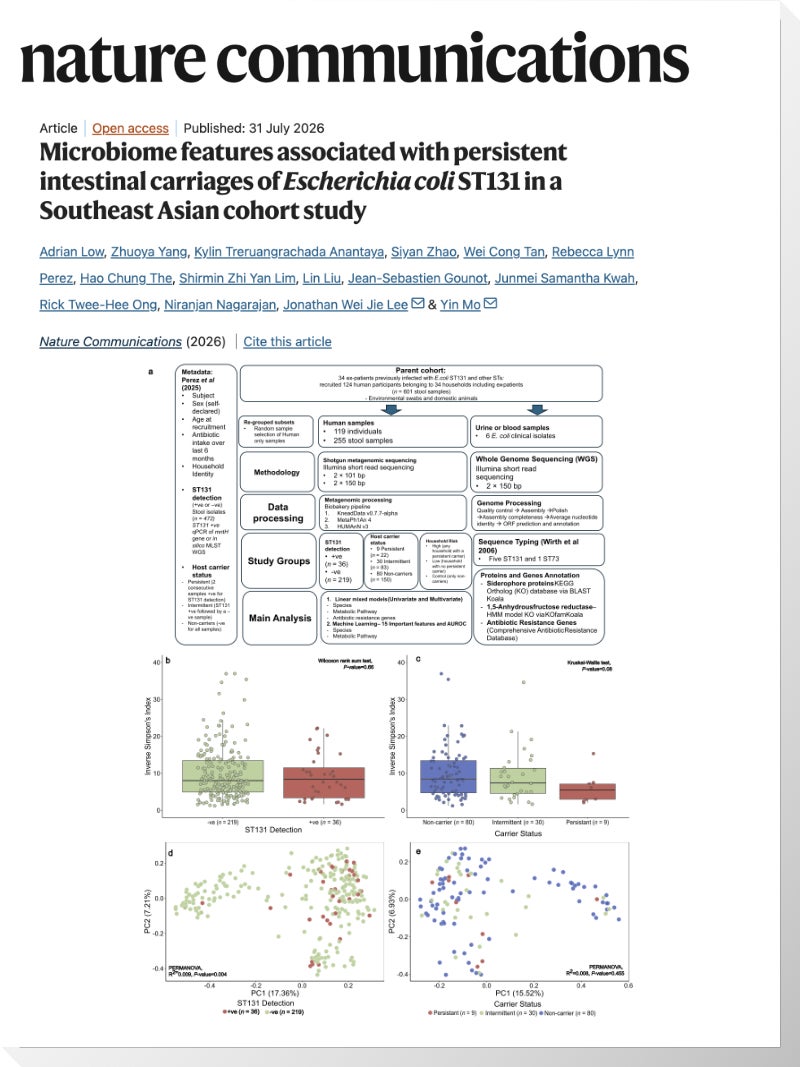
Escherichia coli sequence-type 131 (ST131) is the dominant global extraintestinal pathogen capable of asymptomatic intestinal carriage and sustained household transmission, challenging infection control. Despite its clinical significance, the ecological determinants of gut persistence remain poorly understood. We performed shotgun metagenomics on fecal samples to investigate gut microbiome features associated with ST131-positive samples, distinct host carrier statuses (persistent, intermittent and non-carriers) and household risks in a study of a Southeast Asian cohort. Here, we show that ST131 carriage was associated with compositional shifts without reducing species alpha-diversity. Regression analyses identified depletion of commensal taxa and the 1,5-anhydrofructose degradation pathway in ST131-positive samples. Persistent carriers exhibited highly perturbed microbiome enriched with pathobionts, aerobactin- and lipopolysaccharide (LPS)-biosynthesis pathways. Comparing household risk groups to control, revealed that biotin biosynthesis and 1,5-anhydrofructose degradation may influence ST131 co-colonization through both direct and indirect mechanisms. Machine learning analyses identified metabolic pathways as stronger discriminators of persistent carriage than taxonomic features. Genomic-resolved analysis of clinical ST131 isolates revealed conserved genes for iron-acquisition, LPS and antibiotic resistance determinants. Overall, while commensals and metabolism may influence initial ST131 colonization, persistent carriage is associated with specific microbial and metabolic adaptations, providing potential targets to limit intestinal ST131 persistence.