A soft bioelectronic system with a responsive hydrogel neural interface for direct force quantification and real-time intraoperative craniocerebral injury monitoring
- October 07, 2026
Bo Pang, Ganguang Yang, Qihong Cheng, Sen Zhou, Zhixin Wang, Wang Xuan, Yuqi Qiu, Hangyu Gong, Tianzhao Bu, Bin Xie, Peng Fu, Zhouping Yin, Chwee Teck Lim, Changsheng Wu, Xiaobing Jiang & Hao Wu
Abstract
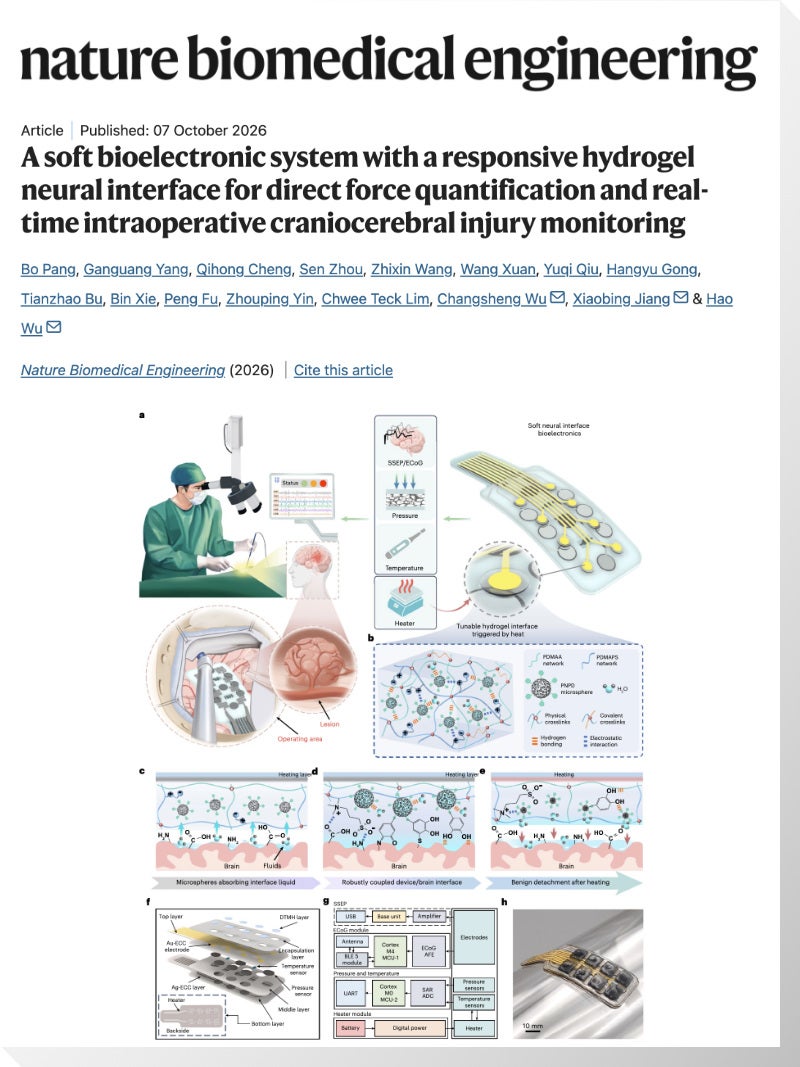
In craniotomies, the surgical manipulation of instruments inherently involves applying mechanical forces to brain tissues, potentially causing brain damage. Currently, there is no direct method to quantitatively monitor craniocerebral injuries. Here we report a soft neural interface bioelectronic system (SNIBS) for real-time monitoring of craniocerebral injury throughout neurosurgery. On the basis of the thermally triggered swelling/deswelling of hydrogel microspheres, the hydrogel interface achieves seamless integration with the brain cortex for recording high-fidelity signals during surgery while ensuring benign detachment to prevent brain damage after surgery. The SNIBS enables the monitoring of contact pressure, somatosensory evoked potentials, electrocorticography and temperature, providing a direct method of assessing neural status. The correlation between somatosensory evoked potential and cortical neural pathway damage caused by pressure is revealed by SNIBS. Evans blue staining and magnetic resonance imaging confirm that contact pressure higher than 80 kPa causes irreversible craniocerebral injury. Validated in rabbit brain tumour excision models, the SNIBS enables surgeons to quantify forces to avoid craniocerebral injury. The presented technology holds strong potential for establishing safety evaluation standards for neurosurgery.