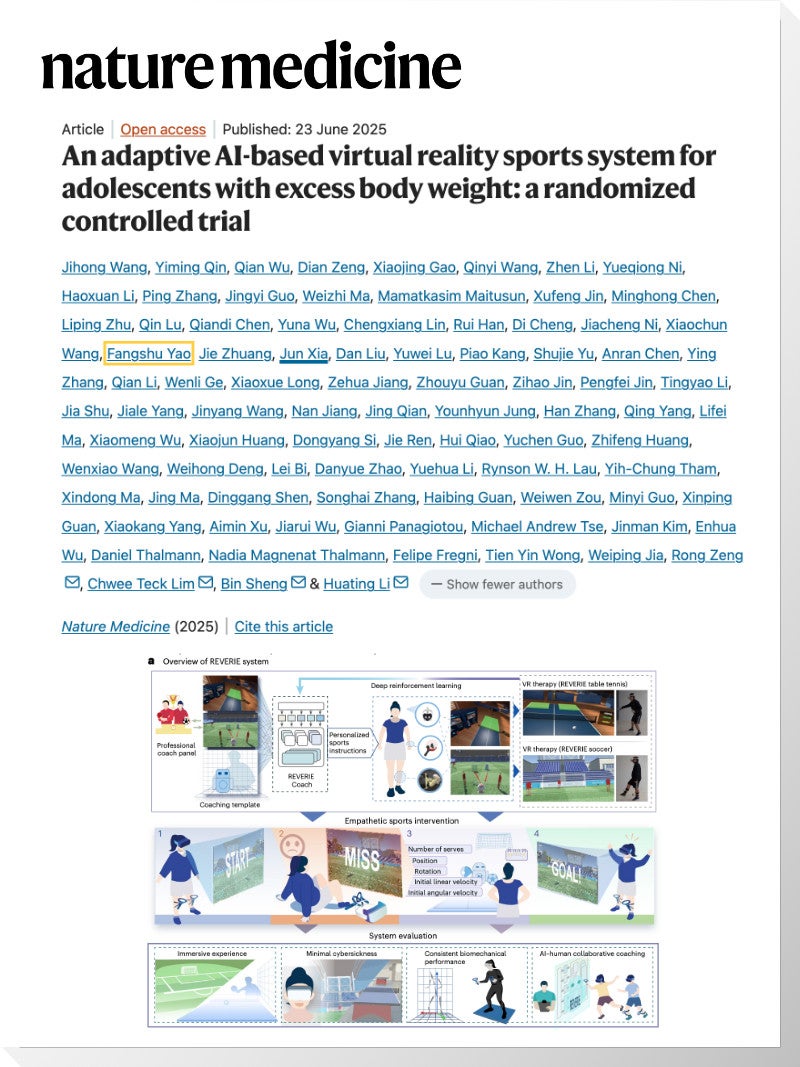
An adaptive AI-based virtual reality sports system for adolescents with excess body weight: a randomized controlled trial
- June 23, 2025
Jihong Wang, Yiming Qin, Qian Wu, Dian Zeng, Xiaojing Gao, Qinyi Wang, Zhen Li, Yueqiong Ni, Haoxuan Li, Ping Zhang, Jingyi Guo, Weizhi Ma, Mamatkasim Maitusun, Xufeng Jin, Minghong Chen, Liping Zhu, Qin Lu, Qiandi Chen, Yuna Wu, Chengxiang Lin, Rui Han, Di Cheng, Jiacheng Ni, Xiaochun Wang, Fangshu Yao, Jie Zhuang, Jun Xia, Dan Liu, Yuwei Lu, Piao Kang, Shujie Yu, Anran Chen, Ying Zhang, Qian Li, Wenli Ge, Xiaoxue Long, Zehua Jiang, Zhouyu Guan, Zihao Jin, Pengfei Jin, Tingyao Li, Jia Shu, Jiale Yang, Jinyang Wang, Nan Jiang, Jing Qian, Younhyun Jung, Han Zhang, Qing Yang, Lifei Ma, Xiaomeng Wu, Xiaojun Huang, Dongyang Si, Jie Ren, Hui Qiao, Yuchen Guo, Zhifeng Huang, Wenxiao Wang, Weihong Deng, Lei Bi, Danyue Zhao, Yuehua Li, Rynson W. H. Lau, Yih-Chung Tham, Xindong Ma, Jing Ma, Dinggang Shen, Songhai Zhang, Haibing Guan, Weiwen Zou, Minyi Guo, Xinping Guan, Xiaokang Yang, Aimin Xu, Jiarui Wu, Gianni Panagiotou, Michael Andrew Tse, Jinman Kim, Enhua Wu, Daniel Thalmann, Nadia Magnenat Thalmann, Felipe Fregni, Tien Yin Wong, Weiping Jia, Rong Zeng, Chwee Teck Lim, Bin Sheng & Huating Li
Abstract
Adolescents with obesity face numerous health risks and encounter barriers that lead to physical inactivity. We developed a virtual reality sports system, named REVERIE (Real-World Exercise and VR-Based Exercise Research in Education), which used deep reinforcement learning to train transformer-based virtual coaching agents, offering immersive and effective sports guidance, with biomechanical performance comparable to real-world physical sports. We integrated REVERIE into a randomized controlled trial involving an 8-week intervention in adolescents with excess body weight (n = 227). Participants were randomized (1:1:1:1:1) to physical table tennis, physical soccer, REVERIE table tennis, REVERIE soccer or control. REVERIE sports intervention was effective in reducing primary outcome fat mass (mean −4.28 kg (95% confidence interval (CI) −6.35 to −2.22), relative to control), with no significant difference compared with physical sports (mean −5.06 kg (95% CI −7.13 to −2.98), relative to control). For secondary outcomes, decreases in liver enzymes and low-density lipoprotein cholesterol levels were found in physical and REVERIE sports groups compared to control. Physical and REVERIE sports showed improvements in physical fitness, psychological well-being and sports willingness after an 8-week intervention, which remained at the 6-month follow-up in the REVERIE sports group. REVERIE sports demonstrated superior cognitive enhancements compared to physical sports in exploratory analyses, as evidenced by olfactory tests (total score: mean 2.84 (95% CI 1.15 to 4.53)) and working memory paradigm (2-back accuracy: mean 10.88% (95% CI 1.19% to 20.56%)). Functional magnetic resonance imaging exhibited that REVERIE sports enhanced neural efficiency and neuroplasticity. Multi-omics analyses revealed distinct changes induced by REVERIE sports that were closely associated with cognitive improvement. Minimal injury rates were 7.69% for REVERIE and 13.48% for physical sports, with no serious adverse events. Collectively, this study demonstrates that the virtual reality sports therapy could provide an empathetic approach to addressing adolescent obesity, offering comprehensive improvements in physical, psychological and cognitive health beyond mere weight loss.