A soft biosensor with printable responsive hydrogel interfaces for detection and differentiation of blood circulation complications
- January 29, 2026
Yuqi Qiu, Ganguang Yang, Zhixin Wang, Bo Pang, Sen Zhou, Qingyang Zheng, Tianzhao Bu, Jia Tian, Bing Xue, Junhak Lee, Yeonsik Choi, Zhouping Yin, Changsheng Wu, Yutian Liu, Hao Wu
Abstract
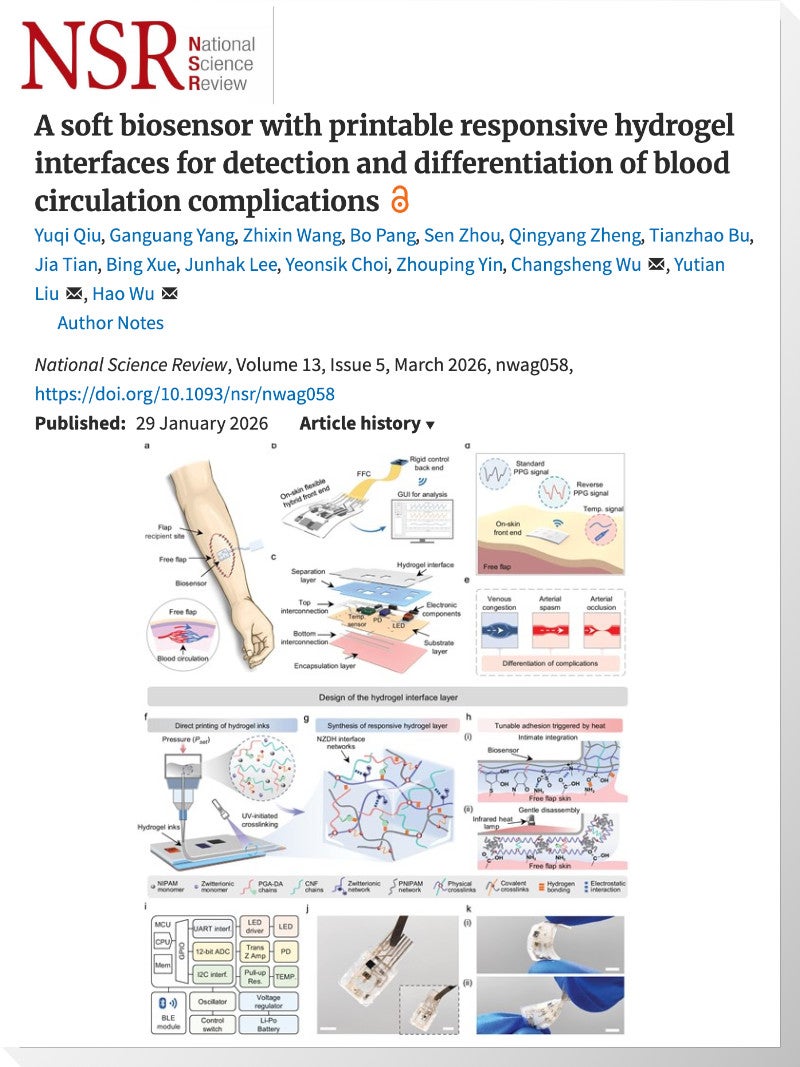
Flexible electronics for healthcare applications have been drawing significant attention and show great promise for monitoring blood circulation (e.g. postoperative monitoring of free flaps). However, existing methods for design and fabrication of interfaces with human skin still cannot meet the challenging clinical requirements of superior adhesion during monitoring, and avoiding wound damage during peel-off. Here, we propose a soft biosensor with universal responsive hydrogel interfaces for detecting blood circulation complications. Particularly, we develop thermoresponsive and printable hydrogel inks to rapidly achieve high-precision patterning and wide-range adhesion regulation of interface layers. In clinical cases, the hydrogel biosensor can establish robust hydrogel/flap skin coupling for high-fidelity signal acquisition during monitoring, and ensure benign detachment to prevent tissue injury after monitoring. We achieve precise arterial perfusion monitoring based on the perfusion index (PI) via an 810 nm light source. Additionally, we propose a new metric, the balance index (BI), to monitor venous congestion. By analyzing BI, PI and skin temperature, the biosensor enables accurate detection and differentiation of blood circulation complications. The printable thermoresponsive hydrogel can be adopted as a universal interface in flexible electronics for healthcare applications, and the biosensor represents a promising platform for blood circulation monitoring.