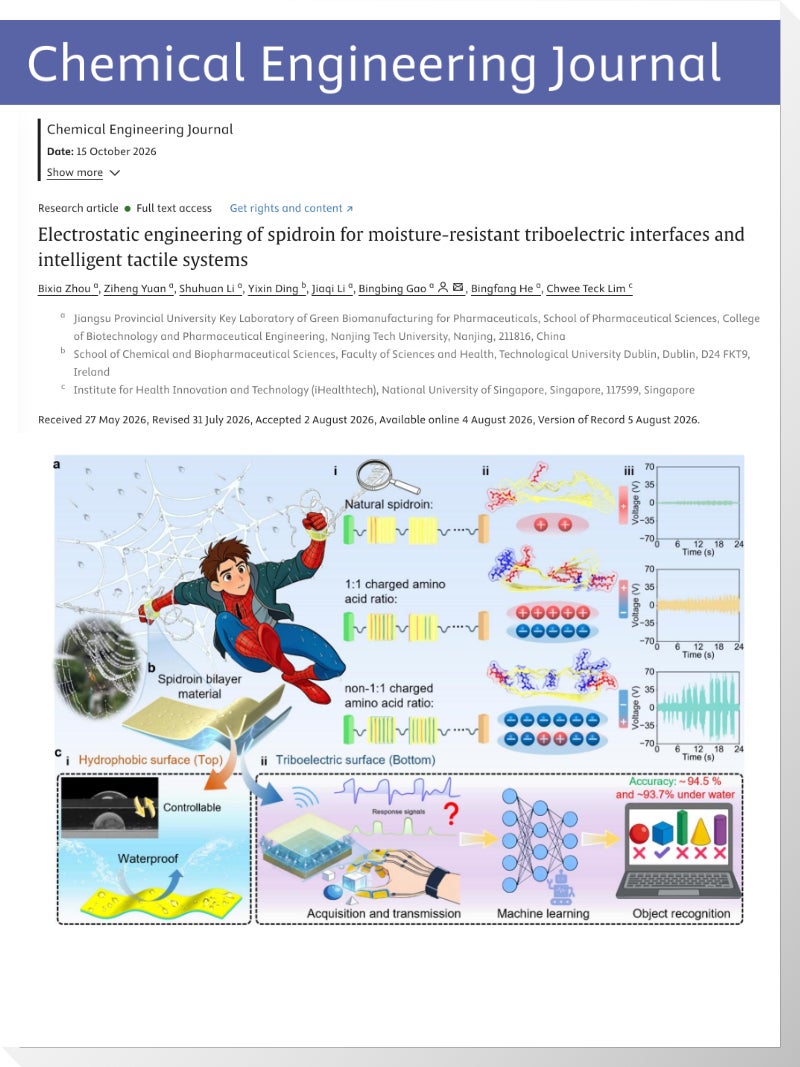
Electrostatic engineering of spidroin for moisture-resistant triboelectric interfaces and intelligent tactile systems
- August 24, 2026
Bixia Zhou, Ziheng Yuan, Shuhuan Li, Yixin Ding, Jiaqi Li, Bingbing Gao, Bingfang He, Chwee Teck Lim
Abstract
Spider silk proteins (spidroins) combine exceptional mechanical strength with hierarchical architectures, offering a compelling platform for bioelectronic materials. However, their application in high-performance triboelectric nanogenerators (TENGs) is limited by poor control over their molecular interactions, surface charge properties, and environmental stability. Here, we report a previously unexplored electrostatic engineering strategy at the protein sequence level, enabling regulation of charge distribution and surface wettability in recombinant spidroins. By rationally introducing charged residues into amorphous regions while preserving β-sheet crystallinity, we establish a charge-imbalanced spidroin systems that enhance both triboelectric charge generation and retention at the molecular level. Simultaneously, modulation of polar residues enables tunable wettability, yielding variants ranging from hydrophilic to hydrophobic. The engineered spidroins exhibit enhanced interfacial polarization and charge trapping, achieving up to a 14.5-fold increase in triboelectric output. This electrostatic programmability further enables the construction of asymmetric Janus bilayers that decouple charge generation from moisture protection. The resulting devices maintain stable electrical output over a wide humidity range (25–99% RH) with excellent durability. Integrated with machine learning, the intelligent tactile sensing system achieves a recognition accuracy of 94.5% under ambient conditions and maintained a comparable accuracy of 93.7% under aqueous conditions. This work establishes a molecular-to-device design paradigm for programmable protein materials, advancing sustainable wearable energy systems and biointegrated electronics.