Wearable Technology Workshop 2025
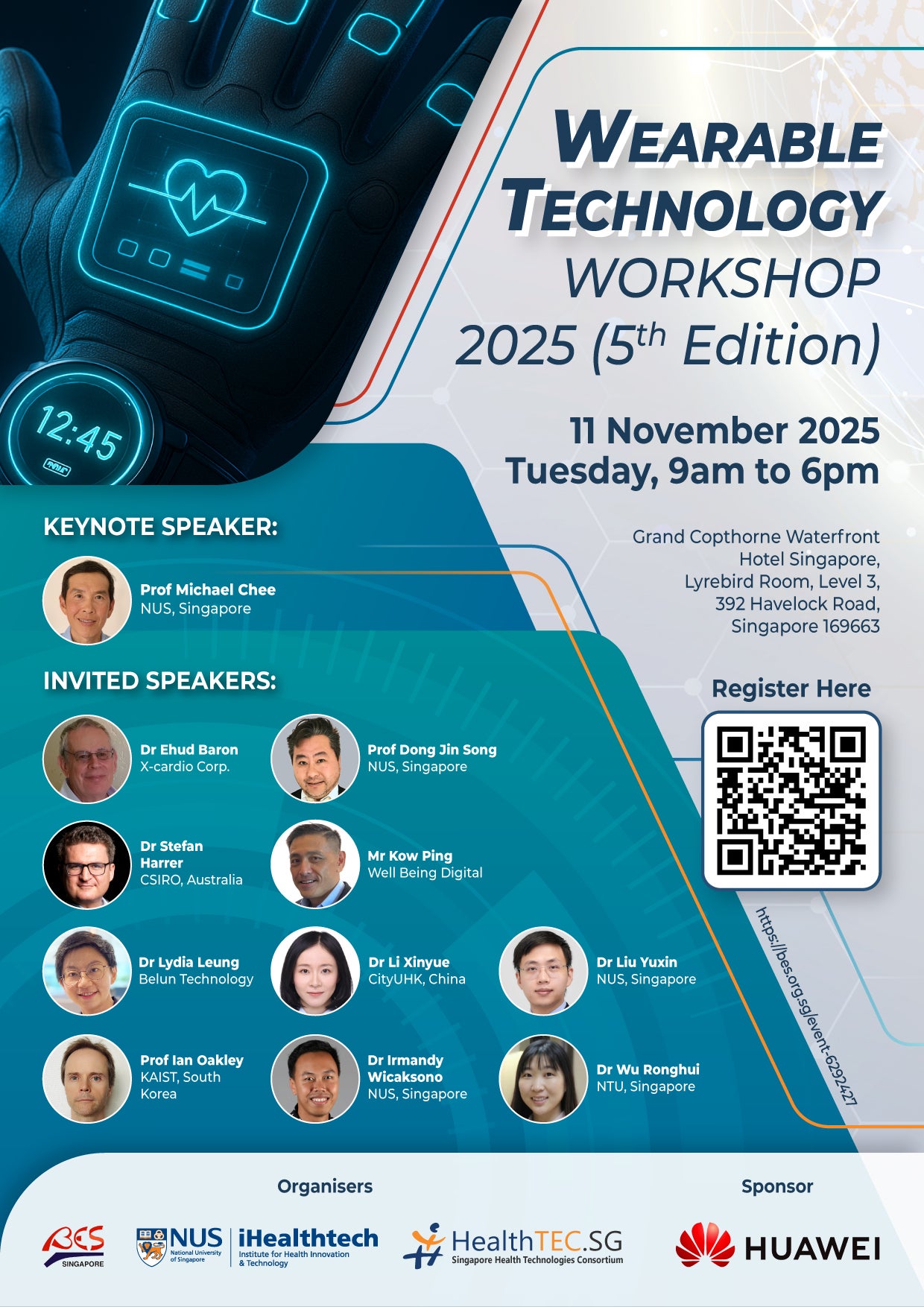
🗓11 November 2025
📍Grand Copthorne Water Front Hotel, Lyrebird Room, Level 3, 392 Havelock Road, Singapore 169663 [Map]
🖋️Registration: [Link]
PROGRAMME
|
Time (SGT)
|
11 Nov, Tuesday
|
|
08:30- 09:00
|
Registration
|
|
09:00 – 09:10
|
Opening Address by
A/Prof Raye Yeow, President of BES
|
|
09:10 – 10:00
|
Keynote Talk
Wearable Health Trackers to Health Benefit
Prof Michael Chee, NUS, Singapore
|
|
10:00 – 10:40
|
Advanced Statistical and AI Methods for Wearable Sensor and Multimodal Data Analysis
Dr Li Xinyue, CityUHK, China |
|
10:40 – 11:00
|
Coffee Break |
|
11:00 –11:40
|
Artificial Intelligence-Enhanced Epileptic Seizure Detection with Wearables
Dr Stefan Harrer, CSIRO, Australia
|
|
11:40 – 12:20
|
Smart textiles for Personalized Healthcare and Sustainability
Dr Wu Ronghui, NTU, Singapore
|
|
12:20 – 13:30
|
Lunch |
|
13:30 – 14:10
|
Mobility and Wearable Devices
Prof Ian Oakley, KAIST, South Korea |
|
14:10 – 14:50
|
When Regular Blood Pressure Fail but Wearable Succeeds to Save Your Life during Sleep
Dr Ehud Baron, CEO of X-cardio Corp. |
|
14:50 – 15:30
|
Soft Technologies: Sensate and Computational Fabrics for Wearable Applications
Dr Irmandy Wicaksono, NUS, Singapore
|
|
15:30 – 15:50
|
Coffee Break |
|
15:50 – 16:30
|
Trusted Sports Analytics and Reasoning Beyond LLM
Prof Dong Jin Song (Zoom), NUS, Singapore |
|
16:30 – 17:10
|
Sensing Epidermal Solid-state Biomarkers
Dr Liu Yuxin |
|
17:10 – 17:30
|
From Wear to Hear : The Research, the Market and the Unicorn Maker
Kow Ping, CEO of Well Being Digital |
|
17:30 – 16:50
|
Medical Wearables, AI, Sleep and Preventive Healthcare
Lydia Leung, CEO of Belun Technology |
|
17:50 – 18:00
|
Closing Remarks |
|
18:30 – 20:30
|
Dinner |
SPEAKER BIOGRAPHIES
Prof Michael Chee
Professor Michael Chee, MBBS, FRCP(Edin) is the Director of Centre for Sleep and Cognition at the National University of Singapore Yong Loo Lin School of Medicine. He is a pioneer clinician-scientist in Singapore who has won the National Outstanding Clinician-Scientist Award (2009) and is a three-time award winner of the National Medical Research Council’s top tier Clinician-Scientist STaR award (2007, 2013, 2019). He is an inaugural Fellow of the Organisation for Human Brain Mapping.
As an esteemed Sleep Researcher, Professor Michael Chee’s work on sleep over the last 20 years has focused on characterising and alleviating the negative impact of sleep deprivation on cognitive performance, wellbeing and health using innovative cognitive tests as well as a wide range of instrumentation including EEG, MRI, wearable devices, and ecological momentary assessments. His team ran 5 editions of the adolescent ‘Need for Sleep Studies’ – a 2-week sleep camp investigating the effects of different doses of sleep on vigilance, memory and mood.
Renowned as a leading Sleep Researcher, he has led work on non-invasive stimulation technologies to enhance sleep, a series of intervention studies involving sleep education and starting school later to help adolescents sleep longer, developed smartphone apps to assess time use and to probe sleep and daytime wellbeing, as well as multiple papers investigating the neural mechanisms of sleep loss as well as the benefit of naps. His 200+ publications include contributions to Ann Rev Psychol, PNAS, Neuron, J Neuroscience, Am J Psychiatry, Neurology, Sleep and NeuroImage. His research has attracted over $50 million in funding as Principal Investigator.
In the sleep field, he has served as Vice President (2013-2014) and President (2016-2018) of the Singapore Sleep Society, given plenary or keynote talks at top conferences such as World Sleep, Organization for Human Brain Mapping and the American Academy of Sleep Medicine, consulted for AIA and presently sits on the editorial boards of Sleep, Imaging Neuroscience and Current Opinion in Behavioral Sciences.
He has also written numerous commentaries on sleep and public health and has appeared on television, internet, and international print media in relation to his advocacy work for sleep, which has been cited by the Times, Guardian, Economist, and other influential lay press publications. He has also trained over 80 research staff including 4 Associate Professors, 7 Assistant Professors, numerous research fellows as well as a few medical doctors, clinical psychologists, and founders of two tech start-ups.
Prof Dong Jin Song
Jin-Song Dong is a full professor at the National University of Singapore. His research spans a range of fields, including formal methods, safety and security systems, trusted AI, sports analytics, and verified LLM code synthesis. He served on the editorial board of ACM Transactions on Software Engineering and Methodology, Formal Aspects of Computing, and Innovations in Systems and Software Engineering, A NASA Journal. He has successfully supervised 34 PhD students, many of whom have become tenured faculty members at leading universities worldwide. He is a Fellow of the Institute of Engineers Australia. Jin Song developed Markov Decision Process (MDP) models for tennis strategy analysis using PAT, assisting professional players with pre-match analysis (beating the world’s best). He founded a new international conference series on sports analytics (ISACE). In his spare time, he is a tennis coach and takes pleasure in coaching tennis to his students and his three children, all of whom have reached the #1 national junior ranking in Singapore/Australia. Two of his children have earned US NCAA Division-1 full scholarships.
Dr Stefan Harrer
Dr Stefan Harrer is a globally recognized scientist and intrapreneur at the intersection of artificial intelligence, life sciences, and digital health. Holding PhD (BioNanotech), MSc (Computational Chemistry), and BSc (Biomedical Engineering) degrees from TU Munich and as a recipient of Research Scholarships from MIT and UC Berkeley he spent two decades on three continents turning breakthrough ideas into transformative technologies — from wearable AI predicting epileptic seizures to agentic AI platforms that supercharge scientific discovery. Currently an Honorary Adjunct Professor at the University of Technology Sydney and Director of AI for Science at Australia’s National Science Agency, Stefan leads an innovation and product development program building AI agents as research lab assistants to tackle complex challenges in biology and medicine. He previously held leadership roles at IBM Research, where he pioneered neuromorphic computing, next generation DNA sequencing, wearable neurotech, and AI for clinical trial design — efforts that earned coverage by The Lancet, WIRED, Forbes, and the World Economic Forum. A TEDx speaker, Forbes Technology Council member, Member of the New York Academy of Sciences and advisor to Harvard Medical School, Stefan blends deep technical expertise (74 granted patents, 70+ peer-reviewed publications) with commercial strategy and ethical foresight.
Dr Li Xinyue
Dr Xinyue Li is currently an Assistant Professor in the Department of Data Science, College of Computing, City University of Hong Kong. She received her PhD in Biostatistics from Yale University. Prior to her studies at Yale, she spent one year at Peking University and three years at the University of Chicago, where she earned her B.A. and M.S. degrees in Statistics. Her research lies at the intersection of statistics, AI, and biomedical engineering, focusing on developing advanced methodologies for wearable sensor and multimodal health data analysis. She has developed innovative statistical and computational methods for analyzing wearable sensor data, with impactful applications in sleep, physical activity, circadian rhythms, and geriatric health. In addition to wearables, Dr Li’s work extends to medical imaging, genetics, and multimodal data analysis. By leveraging cutting-edge AI models and integrating diverse data modalities, she aims to advance continuous health monitoring, precision medicine, and intelligent digital health management systems. Dr Li actively collaborates with interdisciplinary research teams across Asia, Europe, and North America, advancing global efforts in wearable analytics and AI-driven healthcare.
Dr Lydia Leung
Dr Lydia Leung is CEO & Co-founder of Belun Technology, which is in the frontier of wearable medical devices and cloud-based AI platform for sleep apnea diagnosis with sleep stages, preventive healthcare and health risk forecast. Prior to joining Belun Technology, she was Founding Director of MedTech at ASTRI during which she established the medical/healthcare electronic team and spearheaded its development. She was responsible for the strategic planning, R&D and patent portfolio of medical devices and telehealth system for chronic disease management.
Dr Leung received her PhD, M.Phil. and B.Eng. degrees in Electrical and Electronics Engineering from The Hong Kong University of Science and Technology. She also holds a M.Sc. degree in Marketing from The Chinese University of Hong Kong. She has published 40+ journals and conference papers and owns 20+ US/China patents.
Dr Liu Yuxin
Dr Yuxin Liu is a Presidential Young Professor of Biomedical Engineering and a Principal Investigator at the Institute for Health Innovation & Technology (iHealthTech) and the N.1 Institute for Health at the National University of Singapore. He obtained his MSc and PhD in Bioengineering from Stanford University. Dr Liu was awarded BME Rising Star (ICBME), Wellcome Leap Performer, and was selected as one of the “Innovators Under 35” (Asia Pacific) by MIT Technology Review. His research interests include tissue-mimicking brain-machine interfaces and wearable electronics.
Prof Ian Oakley
Ian Oakley designs the next generation of wearable and mobile interactive systems. His work addresses fundamental questions about how we interact with the technology we wear and carry: How can devices understand us through touch, motion, and biosignals? How do we authenticate securely on devices with limited displays? How can haptic feedback make interactions more intuitive and eyes-free? This research is grounded in an unusual interdisciplinary trajectory. Oakley holds degrees in both Computing Science and Psychology from the University of Glasgow and spent a decade as faculty in Industrial Design at UNIST, bringing design thinking and psychological methods to technical problems. Now a full professor in Electrical Engineering at KAIST, he bridges human-centered design with systems engineering as director of the Wearable and Interactive Technology Lab.
Dr Irmandy Wicaksono
Irmandy is an Assistant Professor (Presidential Young Professorship) at the Division of Industrial Design, National University of Singapore, where he directs the Soft Technologies Lab. He holds an M.Sc. in Electrical Engineering and Information Technology from ETH Zurich and an S.M. and Ph.D. in Media Arts and Sciences from the MIT Media Lab. Irmandy has worked with various companies and institutions in fields such as fashion and wearable technology, flexible-stretchable devices, and consumer electronics.
His multidisciplinary research explores digital fabrication and the system integration of intelligent textiles and sensor-actuator networks across scales, with applications spanning health and well-being, human-computer interaction, interactive arts, architecture, and beyond. Irmandy’s work has been featured in academic and media outlets across art, design, science, and technology, including IEEE, ACM, Nature, Popular Science, TechCrunch, Dezeen, and Domus Magazine. His projects and installations have also been exhibited in several venues, including Burning Man, SXSW, the MIT Museum, Cambridge Science Festival, Boston Fashion Week, Lexus Intersect Tokyo, and the World Economic Forum.
Dr Wu Ronghui
Ronghui Wu is an assistant professor in the School of Materials Science and Engineering at NTU Singapore. She got her PhD degree from Donghua University and was a postdoc researcher at the Ulsan National Institute of Science and Technology and the University of Chicago. She has published over 40 papers in international journals such as Science, Nature Chemical Engineering, Advanced Materials, etc. She has filed 16 patents worldwide, 14 of which have been granted, with 5 successfully transferred. She has received several international honors, including the Nanyang Assistant Professorship and the EU Marie Curie Excellence Medal, as well as national recognitions such as the National Scholarship and the Outstanding Doctoral Dissertation Award.